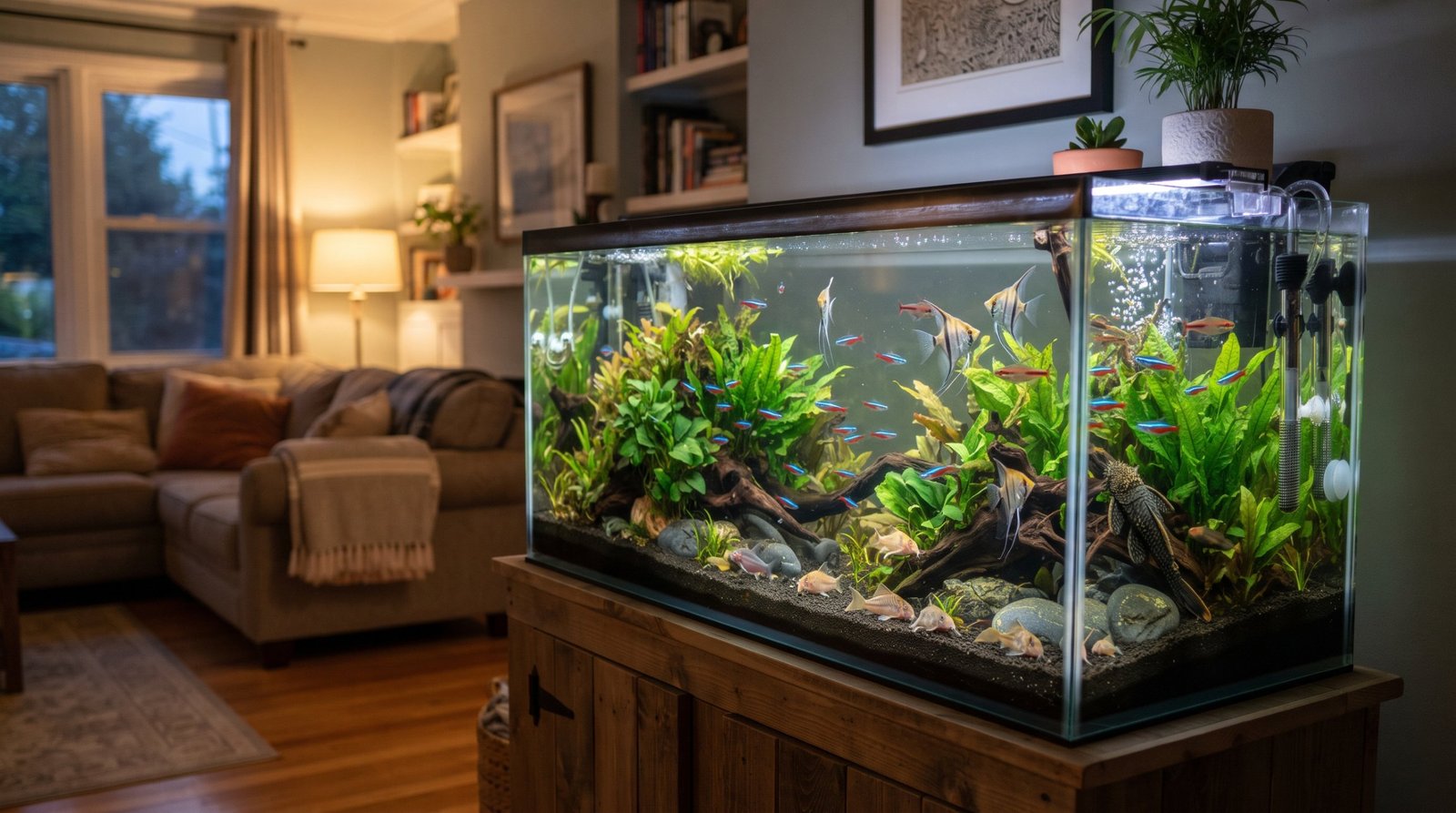
High pH is a common problem, especially with tap water in many regions. Here’s how to safely bring it down — and why most products you’ll find at the fish store are the wrong solution.
Why Is My pH Too High?
Most tap water in the US ranges from pH 7.0–8.5, depending on your municipality. High pH is usually driven by:
- Hard water — mineral-rich tap water is naturally alkaline
- Limestone or crushed coral substrate — constantly buffers pH upward
- Calcareous rocks (limestone, marble, certain sandstones) in the tank
- Low CO₂ — plants and algae consume CO₂, raising pH during the day
What pH Do Freshwater Fish Need?
| Fish Type | Preferred pH |
|---|---|
| Tetras, Discus, Angelfish | 6.0–7.0 |
| Goldfish, White Clouds, Platies | 7.0–8.0 |
| African Cichlids | 7.5–9.0 |
| Most community fish | 6.8–7.6 |
| Betta fish | 6.5–7.5 |
Safe, Natural Methods to Lower pH
1. Driftwood and Botanicals
Indian almond leaves, catappa bark, alder cones, and driftwood release tannins that slowly acidify water and add a natural amber tint. This is the most fish-friendly method — the pH drop is gradual and the tannins have antibacterial properties. Large pieces of spider wood or Malaysian driftwood can drop pH by 0.5–1 full point in a 20-gallon tank.
Spider Wood Driftwood — Check Price on Amazon
As an Amazon Associate, ClearWaterTank earns from qualifying purchases.
2. Peat Moss Filtration
Add a bag of aquarium peat moss to your filter media. Peat releases humic acids that acidify water and soften it. It’s effective but makes water tea-colored. Change the peat every 4–6 weeks as it becomes depleted.
3. RO Water Blending
If your tap water is very hard and alkaline (pH 8+), blending it 50/50 with reverse osmosis (RO) water is the most reliable long-term solution. RO water has a near-neutral pH and very low mineral content. You control the final pH by adjusting the blend ratio.
SpectraPure RO Unit — Check Price on Amazon
As an Amazon Associate, ClearWaterTank earns from qualifying purchases.
4. CO₂ Injection (Planted Tanks)
Dissolving CO₂ in water produces carbonic acid, which directly lowers pH. Pressurized CO₂ systems are standard in planted tanks and naturally keep pH in the acidic range during the day. If your pH rises at night (when plants stop consuming CO₂), a CO₂ system is likely the fix.
What NOT to Do
- Don’t add vinegar — it works but is extremely unstable
- Don’t add pH Down products repeatedly throughout the day
- Don’t chase a “perfect” pH number — stability beats precision
How to Test pH Accurately
Liquid reagent test kits (like the API Master Test Kit) are far more accurate than dip strips. Test at the same time each day — pH naturally rises during daylight hours in planted tanks as plants consume CO₂. For a true baseline, test first thing in the morning before lights on.
API Master Test Kit — Check Price on Amazon
As an Amazon Associate, ClearWaterTank earns from qualifying purchases.